
Build or Buy in South Florida? How to Plan, Finance and Protect Your First Custom Home
A custom home can be the best value you ever create, or the most expensive lesson you ever learn. The difference is decided long before the first shovel: in the numbers, the team and the reviews you insist on.
 By James Papagno
The short answer
Building a custom home in South Florida makes sense when the right lot, layout, storm resilience or long-term value can't be found in existing homes, and when you have the time, reserves and patience for a project that often takes a year or more from design to move-in. Buying makes sense when you need certainty on price and timing. If you build, lock down four things first: a realistic all-in budget with contingency, a vetted team led by a licensed contractor, construction financing arranged before you commit to the lot or plans, and an independent third-party engineer to review your plans, costs and every draw.
Key takeaways
- Compare total cost, not sticker price: land, design, engineering, permits, impact fees, site work, construction, financing costs and a contingency, against the price of a comparable existing home.
- South Florida adds its own rules. Miami-Dade and Broward sit in Florida's High-Velocity Hurricane Zone, and flood zones, soil conditions and local permitting shape the design and the budget.
- Talk to a construction lender before you buy land or finalize plans. Your financing decides your real budget, your builder requirements and your timeline.
- A third-party engineer or construction consultant who reviews your plans, cost breakdown and each draw is one of the best protections a first-time builder can buy.
- Protect every payment. In Florida, record a Notice of Commencement, collect lien releases with each draw and keep builder's risk insurance in place.
Custom home vs. buying an existing home in South Florida
Both paths can build wealth. They ask different things of you. Here is how they usually compare.
| Factor | Build a custom home | Buy an existing home |
|---|---|---|
| Price certainty | Lower until bids and contract are final; contingency is essential | High; you know the price at contract |
| Timeline | Often a year or more across design, permitting and construction | Typically 30 to 60 days to close |
| Design and layout | Built around how you live | Adapted to what exists |
| Storm and flood resilience | Designed to current code, elevation and wind standards from day one | Depends on the age of the home and past upgrades |
| Insurance | New construction to current code can help with windstorm and flood pricing | Older roofs and openings can raise premiums or limit carriers |
| Maintenance | New systems and warranties in the early years | Older systems may need replacement sooner |
| Financing | Construction loan with draws, then permanent mortgage | Standard purchase mortgage |
| Your time | Significant: decisions, meetings and oversight | Mostly concentrated before closing |
What makes building in South Florida different
Wind codes and the High-Velocity Hurricane Zone
The Florida Building Code applies statewide, and Miami-Dade and Broward counties are designated as the High-Velocity Hurricane Zone, with some of the strictest wind requirements in the country. Roof systems, windows, doors and shutters must carry the right product approvals, and structural design has to meet the wind loads for your exact site. Palm Beach County and the rest of the region also face high design wind speeds.
Flood zones and finished floor elevation
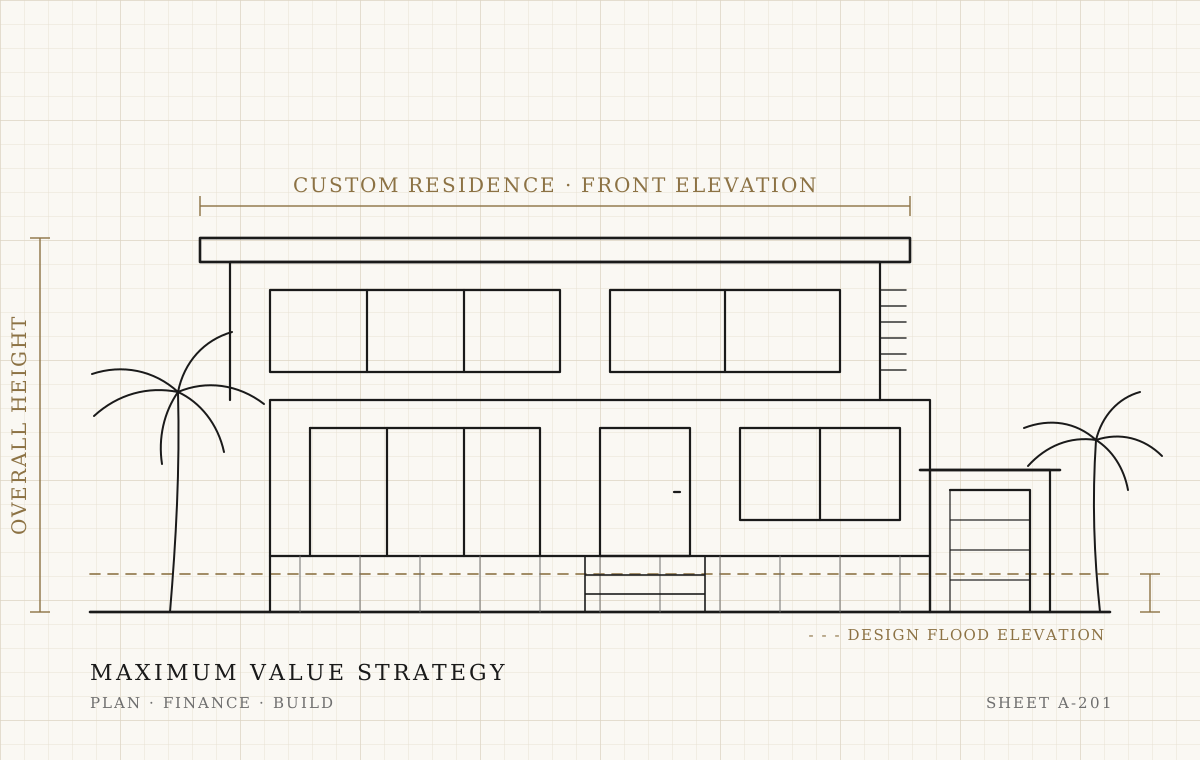
Your lot's FEMA flood zone and the local design flood elevation often decide how high the first floor must sit, which affects foundations, steps, driveways and even what you can build at grade. Many communities require more height than the federal minimum. An elevation certificate will matter for permits and for flood insurance.
Soil, foundations and site work
Limestone, sand, organic muck and high water tables vary block by block. A geotechnical report tells your engineer whether a standard footing works or whether you need soil improvement or deeper foundations, which can move the budget significantly.
Local permitting and community approvals
Each city and county runs its own building department, review times and impact fees. Waterfront lots can add seawall, dock or environmental reviews, and many neighborhoods and HOAs have architectural review boards with their own design rules.
Hurricane season and scheduling
Hurricane season runs from June through November. A good builder plans when the home will be "dried in" (roof, windows and doors installed), how the site will be secured before a storm and how weather days are handled in the contract.
Your custom home roadmap, step by step
Every project is different, but first-time builders who follow this order avoid the most expensive surprises.
Define your goals and all-in budget
List must-haves, square footage, and the total you are prepared to spend, including land, soft costs, construction and a contingency. Decide how much cash you want left after move-in.
Talk to a construction lender early
Understand the down payment, reserves, builder requirements and loan structure before you commit to land or plans, so your design is built to a number you can actually finance.
Complete due diligence on the lot
Order a boundary survey, confirm zoning and setbacks, check the flood zone and design flood elevation, get a soil report, and confirm access to water, sewer or septic, and power.
Assemble your team
Bring in the architect or designer, engineers and a licensed general contractor early enough that design and pricing inform each other.
Design, engineer and price the home
Move from concept to permit-ready construction documents, with a detailed line-item budget, specifications and a construction schedule from your builder.
Commission a third-party plan and cost review
Have an independent engineer or construction consultant review the plans, specifications, budget and schedule before you sign the construction contract and close the loan.
Close the loan, pull permits and record the Notice of Commencement
Finalize the contract, confirm builder's risk insurance, obtain permits and record the Notice of Commencement before work begins.
Build with inspected draws
Funds are released in stages as work is completed and verified, with lien releases collected from the contractor and major suppliers along the way.
Close out and move in
Complete final inspections, obtain the certificate of occupancy, walk through a punch list, collect warranties and final lien releases, and convert or refinance into your permanent mortgage.
The team you need
- Architect or residential designer
- Turns how you live into a plan that fits the lot, the code and the budget.
- Structural engineer
- Designs the foundation, framing and connections for South Florida wind loads and site conditions.
- Surveyor and civil engineer
- Establish boundaries and elevations, and design grading, drainage and site utilities.
- Geotechnical engineer
- Tests the soil and recommends the right foundation before you commit to a design.
- Licensed general contractor
- Verify the license with Florida's Department of Business and Professional Regulation, confirm insurance, and visit homes they have completed.
The team that protects you
- Construction lender
- Structures the loan, sets the draw schedule and helps keep the budget realistic.
- Third-party engineer or construction consultant
- Independently reviews plans and costs, then inspects progress before each draw is paid.
- Real estate attorney
- Reviews the land purchase, construction contract, warranties and lien protections.
- Insurance agent
- Sets up builder's risk coverage during construction and wind and flood coverage for the finished home.
- Owner's representative (optional)
- For larger or complex builds, a professional who manages the project on your behalf and keeps everyone accountable.
Affording the build: how construction loans work
Most custom homes are financed with a construction loan. Instead of paying the full amount at closing, the lender releases money in stages, called draws, as work is completed and inspected. During construction you typically pay interest only on the funds drawn so far, and when the home is finished the loan converts or is refinanced into a permanent mortgage.
| Feature | One-time close (construction-to-permanent) | Two-time close |
|---|---|---|
| Closings | One closing covers construction and the permanent loan | A construction loan now, a separate mortgage at completion |
| Closing costs | Paid once | Paid twice |
| Rate on the permanent loan | Often set at the start | Set when you refinance at completion |
| Flexibility | Less room to shop for the permanent loan later | You can shop for the best permanent loan when the home is done |
| Qualification | Qualify once | Qualify twice, so your finances must hold steady through the build |
What lenders typically look for
Expect a lender to ask for a licensed and insured builder, permit-ready plans and specifications, a signed construction contract, a detailed cost breakdown and schedule, an appraisal based on the completed home, and proof of your down payment and reserves. Conventional construction financing often calls for a meaningful down payment, and equity in land you already own can sometimes count toward it. Requirements vary by lender and program, so get them in writing early.
Build the budget like a lender will
Separate hard costs (materials and labor) from soft costs (design, engineering, permits, impact fees, surveys, insurance, loan fees and interest during construction). Then add a contingency of roughly 10 to 15 percent of construction cost, a figure many builders and lenders use as a starting point, and keep personal reserves outside the loan for surprises and move-in costs.
Anyone can draw a dream home. The value is created by the team that prices it honestly, the engineer who checks it independently and the financing that carries it to the finish line.
Why a third-party engineer review pays for itself
Your architect designs the home and your builder prices and builds it. A third-party engineer or construction consultant works for you and your lender, not for the builder, which is exactly why first-time builders should insist on one. Many construction lenders require a similar review; even when they don't, it is worth commissioning your own.
Before you sign: plan and cost review
The reviewer checks that the plans are complete and consistent, that structural, wind and flood requirements are addressed, and that the budget covers every line item at realistic local pricing. They flag allowances that are too low, missing scopes such as site work or utility connections, and schedules that don't match reality.
During the build: draw inspections
Before each draw is paid, the inspector visits the site and confirms the percentage of work actually completed, so you never pay ahead of progress. Paired with lien releases, this keeps your money and your title protected.
What a good review typically covers
- Plan completeness and code compliance, including wind and flood design.
- Line-item cost review against local market pricing, including allowances and contingency.
- Contract review for scope, change orders, schedule and warranty terms.
- Site visits before each draw, with written reports and photos.
- Tracking of budget, change orders and remaining funds to complete the home.
Do's for first-time custom home builders
- Do get financing guidance before buying land
- A lot you can't finance a home on is an expensive lesson.
- Do finish due diligence before closing on the lot
- Survey, flood zone, soil, zoning and utilities can each change the cost of the home.
- Do get a detailed, line-item bid
- Compare bids on the same plans and specifications, and question any allowance that looks too low.
- Do insist on a written contract
- It should define scope, price, schedule, change-order process, draw schedule, warranties and weather delays.
- Do hire a third-party reviewer
- Independent eyes on plans, costs and draws protect your equity from day one.
- Do plan for insurance early
- Ask about wind mitigation features and elevation choices that can affect long-term premiums.
Don'ts for first-time custom home builders
- Don't choose a builder on price alone
- The lowest bid often becomes the highest cost through change orders and missing scope.
- Don't skip the soil report
- Foundation surprises found after closing are among the most expensive in South Florida.
- Don't pay ahead of completed work
- Tie every payment to verified progress and signed lien releases.
- Don't change the design mid-build without a price
- Get every change order priced and signed before the work happens.
- Don't spend your contingency on upgrades
- It exists for the unknowns. Upgrades belong in the original budget.
- Don't make major financial changes during construction
- New debt or a job change can complicate converting to your permanent loan.
Frequently asked questions
Is it cheaper to build or buy a home in South Florida?
It depends on land cost, the size and finish level of the home, site conditions and current construction pricing. Building often costs more up front than buying a comparable existing home, but it can deliver a newer, code-current and more storm-resilient home with lower near-term maintenance. Compare the full all-in cost of building, including land, soft costs, financing and contingency, against local sales of comparable homes.
How long does it take to build a custom home in South Florida?
From design through move-in, many custom homes take a year or more. Design and engineering, permitting timelines in your city or county, site conditions, material lead times and hurricane season can all extend the schedule.
How does a construction loan work?
A construction loan releases funds in stages, called draws, as work is completed and inspected. You typically pay interest only on the amount drawn during construction. At completion the loan converts to, or is refinanced into, a permanent mortgage. A one-time close loan combines both phases in a single closing; a two-time close uses separate loans.
What does a third-party engineer do on a custom home build?
An independent engineer or construction consultant reviews the plans, specifications, budget and schedule before construction, then inspects the site before each draw to confirm how much work is complete. This protects the owner and the lender from paying ahead of progress and helps catch design gaps, unrealistic allowances and missing costs early.
What is the High-Velocity Hurricane Zone?
It is a designation in the Florida Building Code covering Miami-Dade and Broward counties, with stricter requirements for wind resistance and for approved roofing, windows, doors and other building products. Homes built there must be designed and permitted to those standards.
How much contingency should I budget for a custom home?
Many builders and lenders start with roughly 10 to 15 percent of construction cost, and more for complex sites, waterfront lots or highly custom designs. Keep separate personal reserves outside the loan as well.
This article is general information, not legal, tax, engineering or financial advice, and it is not an offer to lend. Building codes, flood requirements and loan programs change and vary by municipality and lender, so confirm details with licensed professionals for your specific project.